
If you're visiting Paris for a week or more, should you consider splitting your stay between two or more neighborhoods so that you can experience different parts of the city?
In the Sunday edition of my free Paris Discoveries Newsletter, I answer reader questions about Paris travel. Recently, readers have asked whether it makes sense to move from one Parisian neighborhood and hotel to another when time permits.
This article is part of the Paris Discoveries Q&A Archive and brings together my answers based on my own experiences with staying in multiple neighborhoods on longer trips.
You'll find advice about whether splitting your stay is worth doing, how to choose best-for-you neighborhood combinations, hotel suggestions for several popular areas, and.
I've lightly edited, expanded, and updated my original answers, included a few practical tips for making the move from one hotel to another easier, and added photos to make this a more complete Paris travel resource.
Top photo: Notre Dame Cathedral, (c) Paris Discovery Guide
Paris Discovery Guide is a reader-supported publication. If you purchase through our links, PDG may earn a small commission at no additional cost to you. Merci for your support!
What Are Some New Things to Do in Paris?
John's Question:
Susan, after a 10 year gap my wife and I returning to Paris. From the mid-1990's to 2015, we visited multiple times per year renting an apartment near Trocadero. We have seen most of the typical sites.
Can you provide some new or unusual sites or events? We will be in Paris October 22-30. Thanks!!!!
Susan's Answer:
John, thanks for giving me the interesting task of thinking about what's new in Paris, what's changed since 2015 - and the challenging of choosing just the highlights to share in order to keep this answer to reasonable length.
Actually, quite a lot. Here's where I'd start:
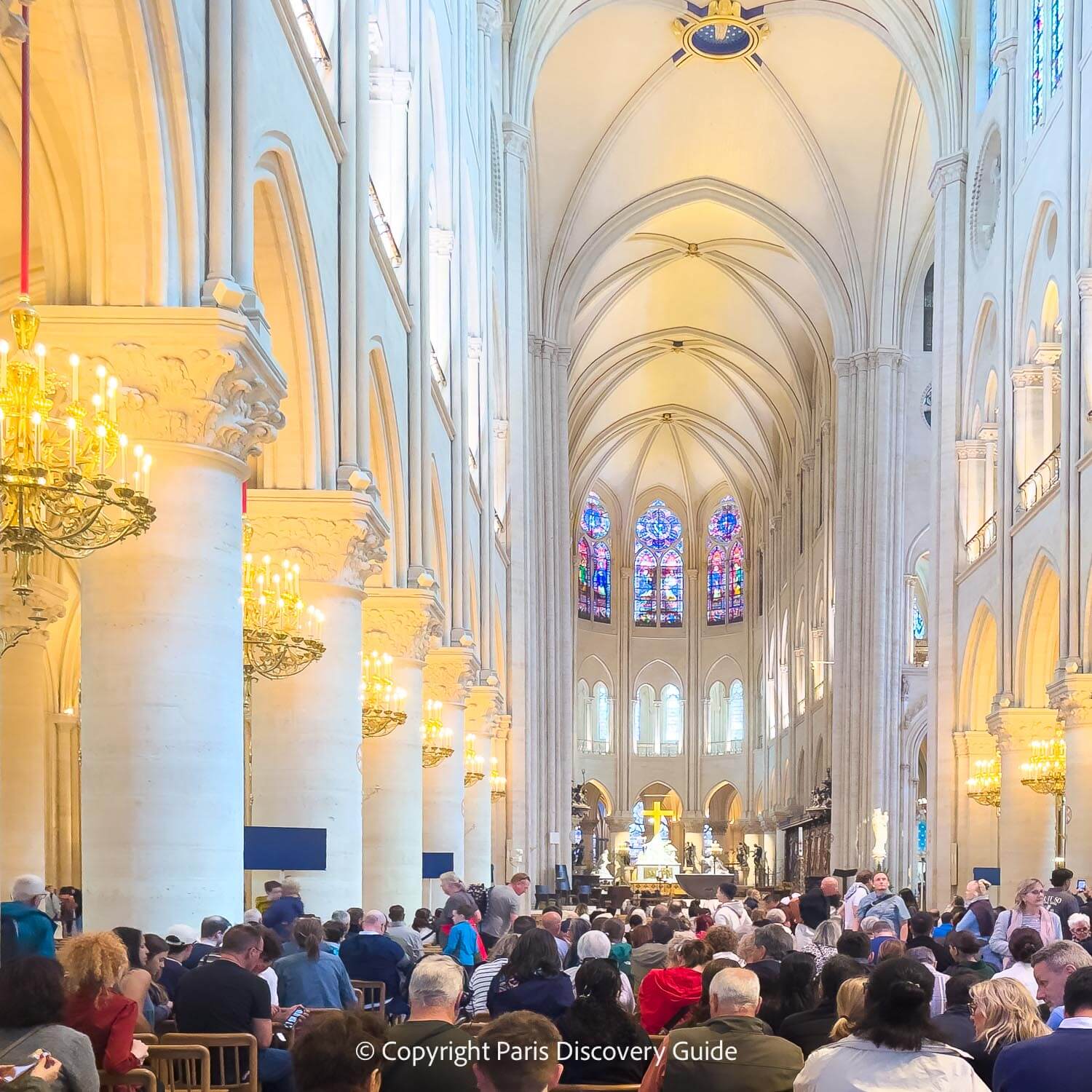
Notre Dame Cathedral - After being closed for over 5 1/2 years since the devastating 2019 fire, the cathedral reopened to the public in December, 2024. Even if you visited Notre Dame during your previous trips, what's new, startling, and worthy of a revisit now is the newly gleaming white interior, thanks to the post-fire cleaning that removed almost 1,000 years worth of grime and smoke. Visually, you get to time-travel back to the early Middle Ages when Parisians had the transformative experience of seeing the cathedral's soaring Gothic arches and its clean, light-filled space for the first time.
New Museums - I can think of over a couple of dozen newly opened or reopened (after significant renovations) major museums and exhibition spaces. (On the other hand, Centre Pompidou will be closed until 2030 for major structural reinforcements.)
Here are my top recommendations (biased by my own preferences) for a visit:
- Pinault Collection at the old Bourse de Commerce near Les Halles (2nd arrondissement) - Revolving exhibitions of contemporary and experiential art (get tickets at the door)
- Fondation Cartier, newly reopened across the street (Rue de Rivoli) from the Louvre in a stunning new space deigned by Jean Nouvel (1st arr) - Contemporary art and visual arts with an international focus (get tickets at the door)
- Galerie Dior, located in Dior's flagship space on Avenue Montaigne (8th arr) - Beautifully curated displays of Christian Dior's designs starting with pieces from his 1947 "New Look" collection and representing many stages in the House of Dior; tickets are difficult to get and must be booked through the gallery's website
- Fondation Azzedine Alaïa, located on Rue de la Verrerie in the Marais (4th arr) - A small intimate space with about 2 exhibitions a year of the late French-Tunisian designer's haute couture fashions, plus a glimpse his workshop upstairs, untouched since his death - this has become one of my own favorite small museums in Paris (get tickets at the door)
- Citéco | Cité de l'Économie - Housed in a gorgeous private mansion (which you can also tour), this is the first museum in Europe focused on economics, and fascinating interactive and immersive exhibits make it lots of fun - plus it's quite informative (get tickets at the door)
Fun New Experiences
- Atelier des Lumières, located in a former iron foundry (11th arr) - Hour-long immersive experiences as animations of digitized art accompanied by soundtracks of mostly-famous music is projected, larger than life-size, on the walls and ceilings (book online in advance)
- Ground Control, located in an old warehouse near the Gare de Lyon train station (81 Rue du Charolais, 12th arr) - A lively family-friendly "third place" with entertainment and actities, a couple of small boutiques, a bookshop, a food hall area with casual local and global cuisine, and lots of seating, indoor and outside, for people to hang out, relax, eat, drink, and socialize (avoid it on the weekends if you don't like crowds)
A Greener Paris - A number of environmental initiatives during the past decade have improved Paris's air quality, dramatically increased the city's tree count, reduced traffic lanes (and the traffic), added more metro stations and a tram around the edge of the city, and created more parks and other green spaces. Here are a few changes you may notice:
- Riverside parks along both sides of the Seine, in the place of the former traffic-packed highways; in warmer months, they transform into major recreational areas with pop-up food stands, bars, music, dancing, games, and areas where you can spread a blanket and have a picnic or relax
- A fledging "forest" along with flowering shrubs, other plantings, and paths for strollers in front of Hotel de Ville (Paris's city hall), instead of the huge expanse of pavement that previously blanketed the area
- Numerous street-side plantings and tree "islands" throughout the city, in many cases replacing a traffic lane
- Bike lanes everywhere, plus plenty of bike rental lanes (and bike riders, some of whom go faster than the speed of light, so look carefully before crossing streets)
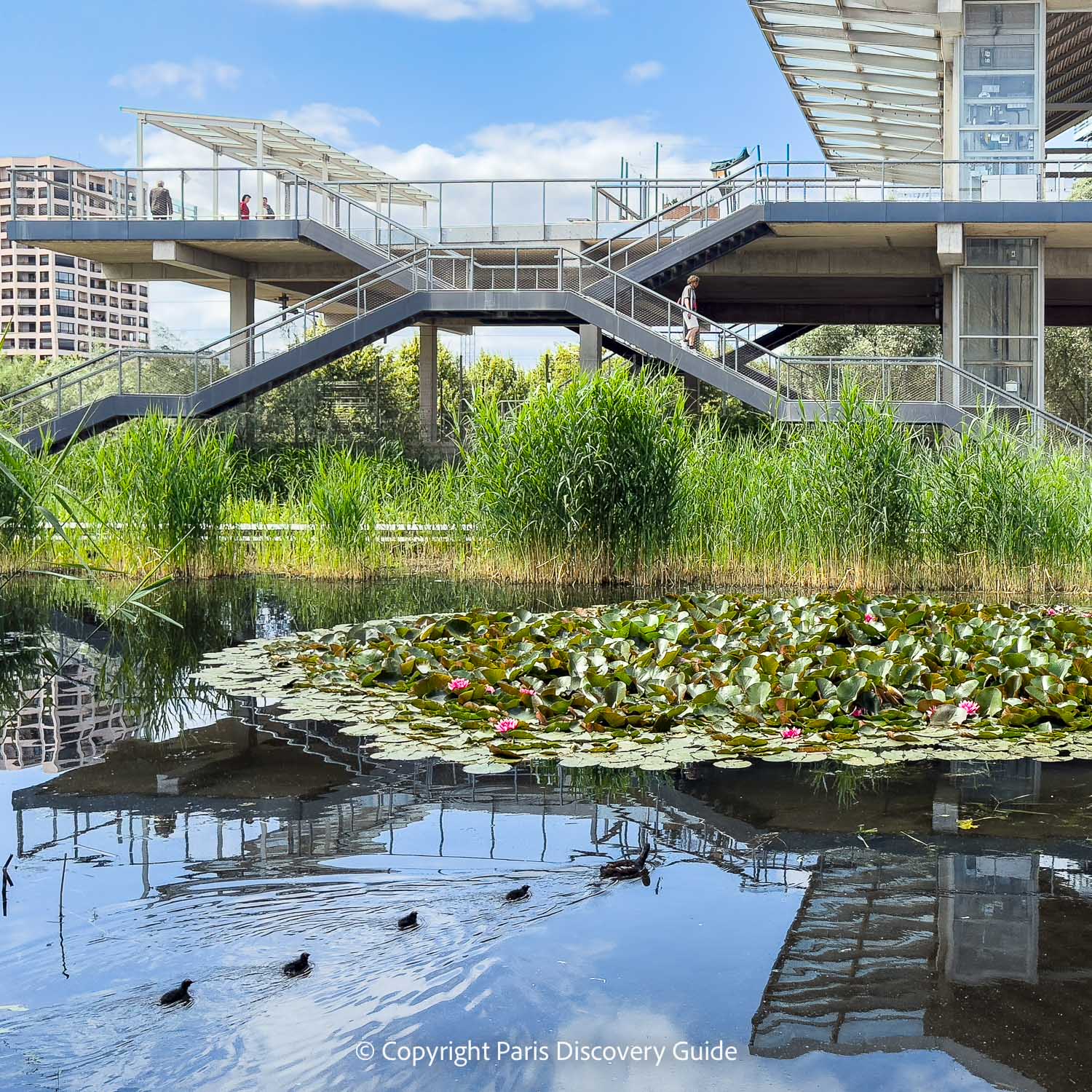
- A large new park (Parc Clichy Batignolles Martin Luther King) with ponds, wildlife, beautiful plants, and sports areas for teens in the 17th arrondissement, covering abandoned railroad tracks, plus numerous other smaller parks and "pocket" gardens
Newly trendy neighborhods - Oberkampf (11th arr) now rivals the Marais for chic boutiques, sizzling nightlife, and small gastronomic cafes, the Canal Saint-Martin (10th) is close behind, Batignolles (17th) and SoPi (South of Pigalle, 9th, especially in the Rue des Martyrs area) have become favorites of Parisian bobos - short for bourgeois-bohemians (meaning upper-middle class) families, and Belleville (parts of the 10th, 11th, 19th) is where a lot of artists, other creators, and 20- and 30-somethings congregate in search of cheaper rents.
I'm sure I'll think of many other changes that I'll wish I'd added - but these should give you some interesting places to visit and check out as you walk around the city.
What Are Some Things We Should Do While We're in Paris?
Erne's Question:
We are coming to Paris in June. Friends have invited us to their place in Paris, in the 3rd arrondissement.
My husband loves birding, trees, and nature! I have a big interest in history, art, design and food.
Please give me advice on where to visit and what to do!
Susan's Answer:
Hi Erne, that sounds like a wonderful trip! Here are some suggestions for each interest that you mention:
Birding and trees for your husband: For quick jaunts, start with Paris's biggest parks, all of which have water features and lots of trees.
On the Right Bank, that would be Parc Monceau on the border of the 8th and 17th arrondissements, Parc Clichy Batignolles Martin Luther King (attracts lots of water birds around its pools and marsh) and nearby Square des Batignolles in the 17th, Parc de la Villette (especially the area around the Science and Industry Museum, which is surrounded by a kind of water-filled moat and marsh) in the 19th, Tuileries Garden in the 1st, and Pere Lachaise Cemetery (not technically a park, but it's a large space that's been pesticide-free in recent years - a good book about it that discusses its biodiversity is The Secret Life of a Cemetery: The Wild Nature and Enchanting Lore of Pere-Lachaise).
On the Left Bank, check out Jardin du Luxembourg between the 5th and 6th, Parc Andre Citroen in the 15th, and Jardin des Plantes in the 5th.
Somewhat further away are Paris's two huge forested parklands: Bois des Boulogne on the west and Bois de Vincennes on the east. Both are easily reachable by metro. Even further - but considered the best bird-watching area in the Paris region - is the Etang de Saint-Quintin in Yvelines, located just beyond Versailles. To get there, you simply hop onto the RER C and get off at the Saint-Quentin en Yvelines - Montigny-le-Bretonneux Station, just 2 stops beyond Versailles. From there, the park and its "pond" - really more like a lake - are an easy 10-minute walk.
History destinations for you: I'd start with the City of Paris's superb history museum, Musée Carnavalet, in the 3rd arrondissement. It covers everything from prehistoric times through the present day. Access to the permanent collections is free, so plan to come multiple times if you want to take it all in.
Other history museums and historical places and monuments include that I highly recommend are the permanent collections at Cluny Museum and at Institut du Monde Arabe (both in the 5th arrondissement), next door neighbors La Conciergerie (medieval castle) and Sainte-Chapelle (a medieval royal chapel with some of the world's most beautiful stained glass) in the 1st arr.
If you have any interest in French maritime history, the National Marine Museum in Trocadero in the 16th (across from the Eiffel Tower) is fascinating. Finally, I also recommend considering Cité de l'Architecture et du Patriomoine, also in the Trocadero neighborhood, which focuses on France's cultural history and architecture and has smaller-than-life-sized models of most of the country's great cathedrals and churches, among other things.
Art & Design: So many possibilities. The Louvre (famous, of course for the Mona Lisa, but it also has vast collections from other periods going back to the Egyptians, plus Napoleon III's actual apartment with original decor) and the Orsay (Impressionists, Post-Impressionists, terrific special exhibitions, a fascination collection of Art Nouveau and Art Deco furniture) are Paris's two most famous art museums, and the Musée des Arts Decoratifs, housed in one wing of the Louvre (but a separate museum), is a vast space dedicated to all forms of design.
But never mind what's famous - see whatever type of art and design you like best, because there's almost certainly a museum devoted to it in Paris. There's an article on Paris Discovery Guide that lists (and in most cases, provides a bit of information about) all of the museums and plus a few major monuments in Paris - over 130 in all, although I'm sure I'm missing a few. It started as my own personal reference notes and I've never finished it, which you'll realize when you see the inconsistent formatting and minimal information about some of the museums - but I published it in case it's helpful to anyone who's interested in the city's huge number of museums. Someday, I really will finish it - but meanwhile, take a look, and then visit those that you find the most interesting!
Things to Do during October in Paris for Repeat Visitors
Pete's Question:
We've been to Paris seven times and have taken in all of the tourist sites.
We're returning again in October and wanted to know what you could recommend that we may find interesting to see and do that wouldn't normally be visited by a first-time visitor.
Some walking is fine but we're not as young as we used to be.
Susan's Answer:
As a frequent return visitor myself, I have lots of recommendations for interesting places to visit in Paris and things to do beyond the Eiffel Tower and the Louvre - although I'm going to start with one - no, actually two, now that I think of it - that you've probably visited before: Notre Dame and Sacre Coeur Basilica.
The reason to visit Notre Dame post-fire is to see what the interior looks like now that 1,000 years of grime have been scrubbed away. It's simply stunning - gleaming white limestone that came from quarries under the Latin Quarter and the 12th arrondissement across the river, and enables you to really see the soaring Gothic arches and vaulted ceiling. There's no need to get an admission ticket at this point, as the line moves as fast as visitors can walk through the door. Once inside, you can simply stand at the back and admire it before leaving, or follow the signs pointing toward the left for a self-guided tour along the Ambulatory around the Cathedral's interior perimeter.
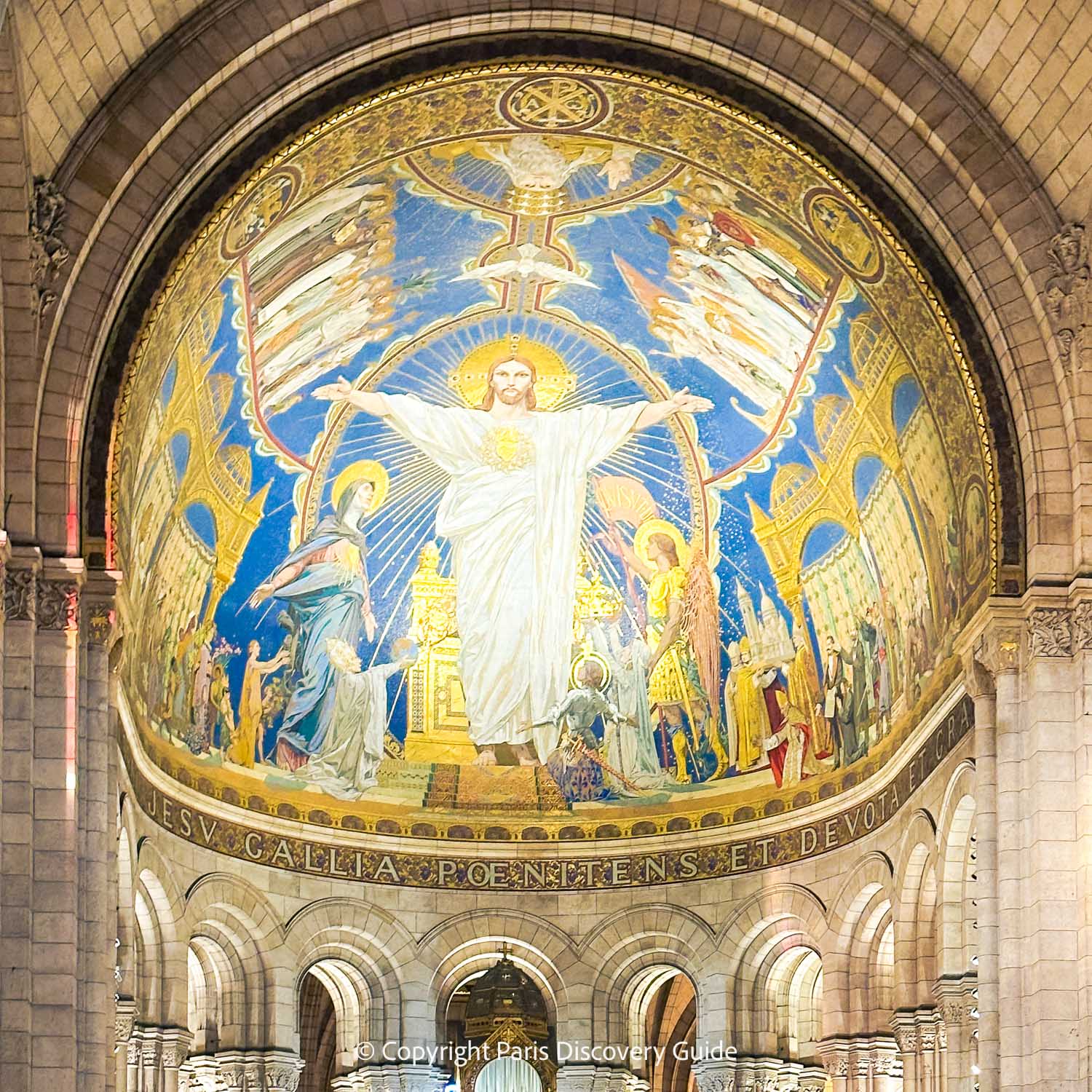
At Sacre Coeur, the reason to revisit is to go inside, if you haven't already done so, to see the truly stunning mosaic ceiling - my photo (above) doesn't do it justice. In addition to being beautiful, it's one of the largest mosaics in the world. Many, or maybe most, visitors to Sacre Coeur miss this because the views from the Basilica's terrace are so mesmerizing that they never go inside.
Now onto other activities. Here are some suggestions, in no particular order:
Paris museums that aren't the Louvre or the Orsay - Here are a few of my favorites, which are interesting and almost never crowded; some are free and most others are relatively inexpensive:
- Liberation of Paris Museum - Free admission to the permanent collection although in my opinion, the special exhibitions have always been worth paying for; in-depth exhibitions about the struggles to liberate Paris from the Nazi occupation during World War II.
- Cité de l'Économie - A new museum in an old mansion with many in-depth exhibits plus interactive and immersive games - very easy to spend 2-3 hours here.
- La Monnaie de Paris - This unusual museum is actually part of the French government-owned mint, founded 864 by King Charles the Bald, and has been making money ever since. The museum mounts fascinating exhibits and incorporates part of the mint's actual manufactoring facility.
- Musée de la Chasse et de la Nature - The general theme here is hunting and nature, but that barely describes the exhibits, which more or less focus on animals in their natural environments, which include hunters, hunting guns, and some spears. It's based on the collections of its two perhaps somewhat eccentric donors.
- Musée Marmottan Monet - The world's largest collection of Claude Monet's paintings, plus a large collection of others by Gauguin, Chagall, Susley, Delacroix, Degas, Caillebotte, Morisot, and others. Although the Orangerie is better known because of Monet's huge water lily paintings, I find his works in this museum more interesting
- Fondation Louis Vuitton - Stunning architecture, and usually blockbuster-type exhibitions of modern or contemporary artists. If you like contemporary art, two others in interesting venues to check out are Fondation Cartier and the Pinault Collection
Food tours - This is a fun way to learn about various city neighborhoods and discover spots you may not have seen before as well as to sample delicious food (in my experience, the amount you'll be eating always adds up to more than you'd probably consume during an average meal). The amount of walking tends to be fairly minimal - maybe half a mile or less during a 2-3 hour period - and they always (in my experience) involve sitting for awhile once or twice. My favorite at the moment, which I highly recommend, is this Covered Passages Food Tour.
Batobus - This hop-on hop-off river bus is one of my favorite ways to spend a day while exploring Paris neighborhoods near the river because you can get off at any or all of the 9 stops, wander around as long as you like, and then get back on
Covered passages - These fall into the "hidden gems" category because unless you know where to look for them, they're easy to miss. Each one is unique. The Covered Passages Food Tour (above) includes five of them, but you may want to go back and spend more time on your own as well as explore some of the others.
Food streets & markets - These are market streets are an integral part of Parisian life and culture, and can be found throughout the city. They're fun to explore, and also a good place to buy something for lunch or a snack. Some of my favorites are Rue des Martrys and newly-revived Rue Cadet (both in the 9th arrondissement), Rue Montorgueil (1st & 2nd), Rue Lévis and Rue Poncelet, both in the 17th, Marché Saint-Germain in the 6th (enter on Rue Félibien or Rue Lobinou unless you want to trek through the Apple store on Uniqlo on the non-food side), Rue Mouffetard in the Latin Quarter (5th), Marché des Enfants Rouges in the Haute Marais (3rd), Rue Cler in the 7th, and Rue des Abbesses in Montmartre (18th).
In addition, Paris has terrific ephemeral farmers' markets in numerous neighborhoods that set up 2-3 days each week. On the Right Bank, Rue Marché Bastille (Thursday, Sunday) is excellent, especially on Sundays, and on the Left Bank in the Latin Quarter, Marché Place Monge (Wednesday, Friday, Sunday) and the smaller Marché Maubert (Tuesday, Thursday, Saturday) are always worth a visit. The farmers' markets open around 7am and close by 2:30pm-3pm - but some vendors will start packing up before then.
I could go on (I haven't touched on all the lesser-known or smaller gardens) - but hopefully this will be enough to get you started. Since you're coming in October, be sure to check out my articles on Paris in October for events and other activities, and Where to See Fall Foliage, which includes a number of parks, gardens, and even cemeteries - in fact, consider visiting Passy Cemetery near Trocadero, which doesn't require too much walking and has some, let's just say, interesting tombs plus lovely glimpses of the Eiffel Tower.
Have a fabulous time exploring!
Ellen's Question about Plein Air Painting

Ellen's Question:
I am renting an apartment in Paris for the month of September. I am an artist and will be painting en plein air.
Do you know if there is a group of Plein air artists that I might be able to join on occasion? It would be a fun way to meet other artists and make friends.
Susan's Answer:
That is a great idea to find a group where you can connect with other artists and make some friends.
Although I've seen plein air painters in a variety of outdoor locations in Paris, they've always been alone, but I would imagine groups do exist.
I'm thinking that unless you're fairly fluent in French, an English-speaking group might be what to look for.
I don't know where to find one, but here are a few organizations you might contact for possible leads:
- American Women's Group in Paris - A social, educational, and cultural group for English-speaking women in Paris
- WICE - An all-volunteer group which provides opportunities for English- and French-speaking members to meet and socialize
- Meetup - This is the Paris branch of the international Meet-Up group, which isn't really a group at all but just a way to post meetups. I see, for example, a drawing meetup at the Cluny Museum in a couple of days - I'm assuming there will also be others throughout the year. (The Cluny is one of the places where I've see artists with easels - outside only, though.) The meetups are probably mostly in French, but some do appear to be in English. You could even post a meetup yourself for what you have in mind - there's a link to do that on the bottom right of the home page.
Can You Recommend a Photographer for an Eiffel Tower Photo Shoot?

Michele Asked:
I'm going to be in Paris the second week of April and wanted to hire a photographer for a photo shoot. Do you have any suggestions on a company or an individual to hire?
I want to focus my shoot around the eiffel tower and take advantage of the cherry blossoms being in bloom, but do you have any specific location recommendations in that area?
Susan's Answer:
There's a link to a small group of photographers whose work I like in this article: https://www.parisdiscoveryguide.com/cherry-blossoms-in-paris.html
It's in the section fairly close to the top labeled "Cherries in Bloom by the Eiffel Tower" and the link itself (Book a VIP photoshoot with a professional photographer) is right above the photo of cherry blossoms by the Eiffel Tower.
The best spot for cherry blossoms around the Eiffel Tower is, honestly, wherever the blooms happen to be the best when you're shooting combined wherever the light is best.
Cherry blossoms are tricky in terms of when they bloom and the weather determines how long as well. The pale pink ones in the photo near the links in the article don't bloom long, but across the river from the tower, there are a number of the deep-pink Kwanzan cherries that usually have a longer bloom time - you can see those closer to the top of the article.
When you book your session, let the photographer know what you want. They're out there with their cameras every day, so they'll know where the flowers are best, as well as the best angle in terms of lighting. A big part of their job is to make you (and the cherry blossoms plus the Eiffel Tower) look good, so they've had a lot of practice in figuring it out.
See Questions & Answers on Similar Topics
Wondering about specific neighborhoods for your Paris visit? You'll find those Q&A archives here:
Paris Discoveries Q&A Archive - See Q&As on all topics
Want to get more questions and answers about Paris travel, or ask your own question?
Sign up for Paris Discoveries and you'll get Paris travel planning tips and the newsletter's Q&A edition delivered straight to your inbox each week.
Paris Discovery Guide is a reader-supported publication. If you purchase through our links, PDG may earn a small commission at no additional cost to you. Merci for your support!
Helpful Related Articles on Paris Discovery Guide
You may also want to read:
- Where Should You Stay in Paris? - 10 recommended Paris neighborhoods and hotels for first-time and return visitors
- Paris Hotels in the Marais - Find the best places to stay in this popular Right Bank neighborhood
- Paris Hotels in Saint-Germain - See top hotel recommendations for this charming neighborhood on Paris's Left Bank